Learn more about the key elements of pet food labels, and what the important things are to consider.
Most reputable pet food manufacturers have adopted the labeling guidelines of the American Association of Feed Control Officials (AAFCO). These regulations are specific in nature, covering aspects of labeling such as the product name, the guaranteed analysis, the nutritional adequacy statement, feeding directions, and calorie statements. Pet food products available in New Zealand will generally meet these minimum requirements. However it is important to note that these are minimum requirements and the quality of the products, while meeting the minimum requirements, vary considerably.
Have you ever looked at the ingredients panel on your pet food? Assuming you have looked at your bag, or can, or roll of pet food, you will recognise some of the ingredients, but chances are it really does not mean a lot to you. Even if you can identify lamb, chicken etc, how do you know if it’s the best quality? And what about all those other ingredients?
This article is not intended to cover all aspects of the ingredients of dog and cat food, but it is intended to give an overview of the key elements.
First of all what should your pet be eating? Dogs, unlike cats, are omnivores. In the wild wolves would dine on the whole carcass of their prey – muscle meat, organs, bones/cartilage and stomach contents which could be plant based. They would also eat berries, leaves, grasses etc as they needed or felt like. Cats, on the other hand, are obligate carnivores – they only eat meat. Accordingly the digestive tract of dogs and cats is designed to utilise primarily meat and fat.
Our pets rely on us, their pet parents, to choose what they eat. While many of us would like to feed raw food or to home cook for our pets, it can be inconvenient and also quite expensive. Since dry kibble was introduced it has become a staple form of pet food in the majority of pet households. So for simplicity in this article we look at the ingredients of dry kibble, although the principles are generally the same for canned or roll products too.
Ingredients on a label must be listed in order of their weight before processing. So you would expect that the first ingredient in any dog or cat food would be a meat product, right? Well, not necessarily…
In Food A example, corn is the primary ingredient.
You also need to watch for ingredient splitting. The label on the right for Food B shows lamb meal as the first ingredient but the next 4 ingredients are rice products – they are all just different forms of rice. So in reality it is likely that the number one ingredient in this food is actually rice, not lamb at all.
Looking at the protein source itself, in Food A the second ingredient on the list is chicken by-product meal. By-products are what are left over from the processing of human food. The American Association of Feed Controls (AAFCO) defines chicken by-product meal as:
consists of the ground, rendered, clean parts of the carcass of slaughtered chicken, such as necks, feet, undeveloped eggs and
intestines, exclusive of feathers, except in such amounts as might occur unavoidable in good processing practice.
What you are looking for is highly digestible protein sources. Protein is required to provide the body with essential amino acids and energy. The more digestible the protein, the more nutrients are absorbed and the less waste produced. The ultimate protein is egg, against which all others are rated, with a digestibility rating of 100%. This is followed closely by muscle meats at 92% (chicken is slightly higher than lamb or beef) and organ meats at 90%.
Carbohydrates, like grains, also contain protein and are used extensively in pet food to boost the protein level. But not all grains are equal. While rice and oats are highly digestible, the digestibility of wheat is 60% and corn is 54% (two grains commonly found in pet foods).
How much you have to feed your dog or cat (and how much comes out the other end!), is a function of the quality and digestibility of the protein source.
In Food B the label shows “lamb meal” and then further down the list “lamb”. Is there a difference? Yes, there is, although the issue is not about quality of the ingredient – both are good. A meat meal is the concentrated form of the meat and will usually contain 300% more protein than fresh meat. Fresh meat is 80% water so once it is cooked the meat content is reduced to just 20% of its original weight, meaning that it would likely appear further down the ingredients list. There is nothing wrong with using both fresh and meal products, the key thing to look out for is that the meals are specific animal meals. In Meat meal, for example, we have no idea of what meat is used. The AAFCO definition is:
the rendered product from mammal tissues, exclusive of blood, hair, hoof, horn, hide trimmings, manure, stomach and rumen contents except in such amounts as may occur unavoidably in good processing practices.
You should look for specific animal meals – chicken (not poultry) meal, lamb (not meat) meal etc
Oils and fats are an important part of a dog and cat’s diet, for skin and coat health, and also for brain development and other key body functions. They are an important source of energy and the quality (i.e. digestibility) varies significantly. Many pet food companies use rendered oils/fats, which is processing of the whole animal tissue into purified fat such as lard, suet, poultry fats or animal fats.
Chicken fat or poultry fat are common ingredients for taste and coat conditioning. Poultry fats are typically less costly than healthier vegetable or salmon oils. Pure fats (e.g. Chicken fat) and oils (e.g. herring oil, salmon oil, canola oil, sunflower oil, flax oil etc ) are more digestible than rendered fats (animal fat, poultry fat).
An important thing to look for in a good quality pet food is what is used to preserve the oil or fat source. Artificial preservatives such as Ethoxyquin, BHA and BHT should be avoided. Most premium pet foods do not use these preservatives (although they may be present in fish meal). Instead they use Mixed Tocopherols (a source of Vitamin E) which has anti-oxidant properties and prevents oil and fat oxidisation.
Carbohydrates are a source of energy. The main source of carbohydrates in dog and cat food has traditionally been grains (rice, wheat, barley, oats, corn etc) but more recently high quality pet food manufacturers are using legumes, potatoes, pumpkin etc either in addition to, or in the case of grain free foods, instead of grains. Once again, the key to digestibility and therefore use of the carbohydrate source is the quality. Many pet foods use parts of the grain rather than the whole grain (e.g. Brewer’s rice, Corn bran, Corn gluten meal, Wheat bran). These ingredients provide less nutrition than whole grains (oats, rice, barley, millet).
Most pet foods contain ingredients to enhance the palatability of the product for our pets. Commonly used flavour enhancers are: chicken digest, animal digest, lamb digest, etc. These are highly rendered ingredients and are cheaper than natural flavours. High quality pet food manufacturers use natural flavour, if they add any flavour at all.
Preservatives are found in pet food to prevent fats and oils from turning rancid and to prevent the growth of moulds. Traditionally
artificial preservatives such as BHA, BHT and Ethoxyquin (known carcinogens) were commonly used in pet foods but over more recent years, better quality pet food manufacturers have eliminated the addition of these controversial ingredients in favour of natural preservatives; typically Mixed Tocopherals (Vitamin E), Vitamin C and Rosemary extract.
While BHA, BHT and Ethoxyquin may not be added by the pet food manufacturer (and therefore not listed on the ingredient list), fish meals may contain Ethoxyquin and unless the manufacturer specifically sources naturally preserved fish meal, your pet may be exposed to this artificial preservative through the inclusion of fish meal in the product. Look for guarantees from the manufacturer that the fish meal is not preserved with Ethoxyquin.
Further down the ingredient list, the “common or usual” names become less common or usual to most consumers. The majority of ingredients with chemical-sounding names are, in fact, vitamins, minerals, or other nutrients. Other possible ingredients may include artificial colours, stabilisers, and preservatives.
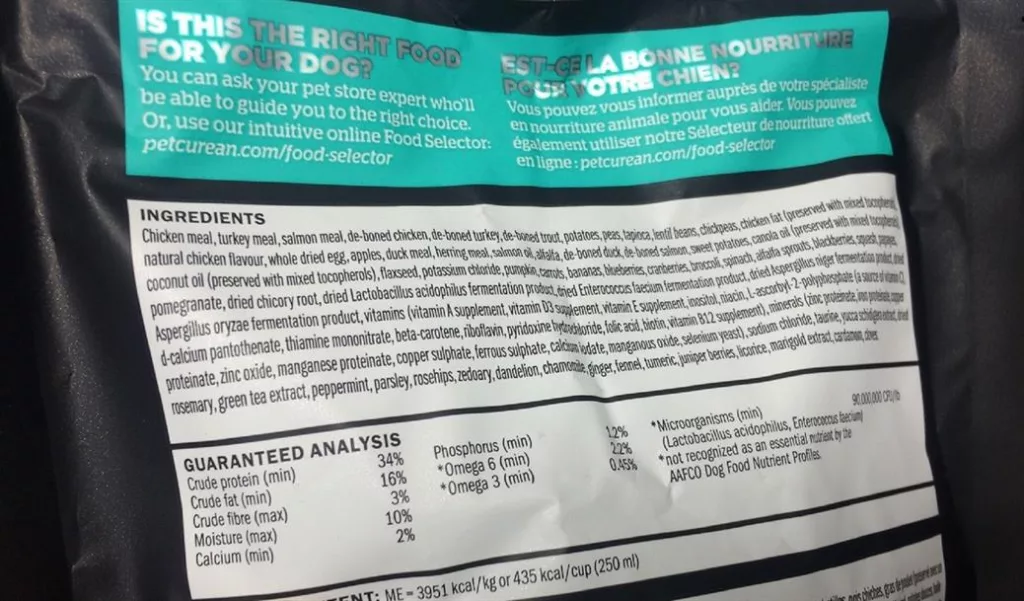
The guaranteed analysis shows the minimum percentages of crude protein and crude fat, and the maximum percentages of crude fibre and moisture. The “crude” term refers to the specific method of testing the product, not to the quality of the nutrient itself.
Some manufacturers include guarantees for other nutrients as well. The maximum percentage of ash (the mineral component) is often guaranteed, especially on cat foods. Cat foods commonly bear guarantees for taurine and magnesium as well. For dog foods, minimum percentage levels of calcium, phosphorus, sodium, and linoleic acid are found on some products.
All percentages are on an “as fed” basis therefore you cannot directly compare the guaranteed analysis of canned food with dry food because the moisture content is different. The guaranteed analysis of dry foods can only be compared if the moisture content of the two products is the same percentage.
Pet foods can vary greatly in calorie content, even among foods of the same type (dry, canned) and formulated for the same life stage. Feeding directions vary among manufacturers, too, so the number of calories delivered in a daily meal of one food may be quite different from another.
If a calorie statement is made on the label, it must be expressed on a “kilocalories per kilogram” basis. Kilocalories are the same as the “Calories” we are used to seeing on food labels. As with the guaranteed analysis, the calorie statement is made on an “as fed” basis, so corrections for moisture content must be made.
There are three ways in which energy is expressed in relation to pet food:
Gross Energy (GE) is measured by the heat produced from burning a food.
Digestible Energy (DE) is determined by feeding trials, it is the difference between the GE in a food, and the GE lost in faeces.
Metabolisable Energy (ME) is a measurement of actual utilisation, it is the difference between the GE in the food, and GE lost in the faeces and the urine. This may be determined using a calculation, and may be expressed as ME=X kcals (kilocalories or calories) per cup on packaging. This is the best way to determine available energy in a food.
Protein and carbohydrates provide equal amounts of energy in the form of calories, while fats supply 2 ¼ times the calories. Contrary to the popular myth that excess energy in pet food causes hyperactivity, excess energy is stored as fat, or excreted in the urine.
Finally, foods that are available in the North American market will have a statement on the bag/can or pack that states whether the food meets the minimum nutritional requirements set by AAFCO (the regulatory body governing the formulation of pet foods). In New Zealand there is no regulatory body that oversees the formulation of pet foods so it is important to check that the food you are purchasing has a nutritional statement.